The Hawes Riots
The Hawes Riots – 1888
A Troubled Family
Richard Hawes married 18-year-old Emma in Atlanta. Their marriage was troubled, and they moved first to Montgomery and then to Birmingham. Richard worked for the Georgia Pacific Railway and was often away running trains between Birmingham and Columbus, Mississippi. Emma was said to be an alcoholic, so their eldest daughter, May, looked after her younger sister Irene and her brother Willie, who was four or five. Fannie Bryant, who cooked and did laundry for the family, helped around the house.
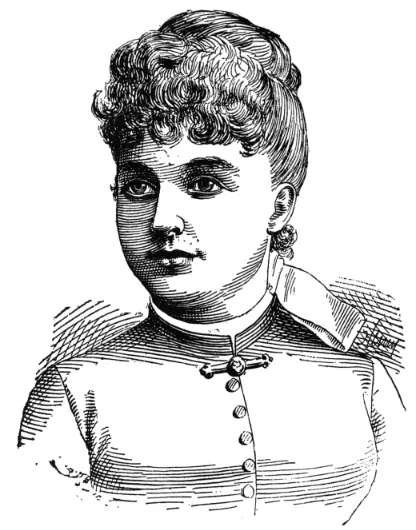
Illustration of Emma P. Hawes, from Goldsmith B. West, The Hawes Horror and Bloody Riot at Birmingham (Birmingham: Caldwell Printing Co., 1888). Reproduced in The Journal of the Birmingham Historical Society, Vol. V, No. 4 (1978).
A Body at East Lake
On Tuesday, December 4, 1888, two teenage boaters found the body of a young girl in East Lake. Jefferson County Coroner Alfred Babbitt ruled it a murder. The body was put on public display at Lockwood & Miller’s Funeral Parlor, and schools let students out early to help identify her. Thousands came to view her. The next day, a local butcher identified her as May Hawes.
The Arrest
Witnesses at the inquest disagreed. Some said Richard was still married to Emma. Others said he had divorced her and gone to Mississippi to marry again. Fannie Bryant testified that she had seen Richard and May help Emma pack for a trip to Atlanta to pick up Willie, who was staying with Richard’s family.
That same afternoon, a telegram reached the Age-Herald saying Hawes had just married Mayes Story in Mississippi. It included the couple’s train route to Atlanta. When the train stopped in Birmingham, police boarded it and arrested Hawes. A reporter noted that Hawes “asked no questions as to which of his children he was accused of having murdered.” He only said he was innocent.
From jail, Hawes wrote to his new bride asking her to forgive him. His new wife said he had told her he was divorced and had one son. He claimed he never mentioned May because she was going to a convent. He never mentioned Irene at all.
Emma and Irene Are Found
Police searched for Emma and Irene. A bloody hatchet and a torn ribbon led them to Lakeview Park, where the Highland Park Golf Course is today. On December 8, they dragged the lake and found Emma’s beaten body, weighted down with iron. Dragging turned up nothing more, so the lake was drained. On the third day, Irene’s body was found about thirty feet from her mother’s, also weighted down. To avoid more unrest, she was buried right away.
The Jail Riot
When news of Emma’s death spread on December 8, a mob of 1,000 to 3,000 people marched on the Jefferson County Jail. Sheriff Joseph S. Smith armed his deputies, warned the crowd, and counted to five. When the mob kept coming, he ordered his men to fire. Ten people died, among them postmaster Maurice Throckmorton. The state militia restored order. Smith and Police Chief O. A. Pickard were arrested but went free the next year after a deadlocked jury.
The Trial
The trial began April 22, 1889, before Judge Samuel Greene. Hawes was charged with all three murders, but prosecutors built their case around May’s death. Witnesses said they saw Richard and May ride the rail to East Lake on the evening of December 3, and then saw Richard, or a man who looked like him, ride back alone. Prosecutors argued that he killed his wife and children so he could marry Miss Story, and that he killed May because she knew what had happened to her mother and sister.
Hawes said he took May to East Lake on December 1, not the 3rd, to go shopping, and that they came home together. He said that when he got back early on December 2, his wife and daughters were gone, and he thought they were visiting friends.
After 55 minutes of deliberation, the jury sentenced him to death on May 3, 1889. The Alabama Supreme Court denied every appeal.
Confession and Execution
In his last month, Hawes reportedly told his brother and a guard that he had paid a man named John Wylie to kill Emma and Irene, and that he then drowned May himself. He later denied saying this.
Sheriff Smith executed Hawes on February 28, 1890. Tickets to the hanging sold on the street for as much as $200. His brother Jim buried him in an unmarked grave at Oakland Cemetery in Atlanta, and no words were spoken over it.
Fannie Bryant and her companion, Albert Patterson, were also sentenced to death for helping Hawes. Bryant died in a prison riot, and Patterson’s sentence was reduced after he testified for the state. The case against John Wylie was dismissed for lack of evidence.
Resting Place
Emma, May, and Irene Hawes lie side by side in unmarked graves at Oak Hill Cemetery (Block 0517). Willie is thought to have been raised by his uncle Jim in Atlanta.
References:
West, Goldsmith B. (1888) The Hawes Horror Birmingham
“Dick Hawes Hanged for the Murder of his Wife and Little Girls: History of the Blackest Crime That Blackens the Pages of Criminal History With the Sensational Features of the Case. Hawe’s Neck Broken.” (February 28, 1890) Dallas Times Herald. [1] – accessed April 10, 2006
Northrup, Jeff. (1978) “The Hawes Riot: All the News Unfit to Print.” Journal of the Birmingham Historical Society. Vol. 5, No. 4
Northrup, Jeff (1979) “The Hawes Affair, Part II.” Journal of the Birmingham Historical Society. Vol. 6, No. 1
Hoole, WIlliam Stanley (1980) The Birmingham Horrors. Huntsville: The Strode Publishers
Jones, Pam. (Spring 2006) “The Hawes Murders.” Alabama Heritage No. 80, pp. 34-40