Charles Linn
Charles Linn
1814 – 1882
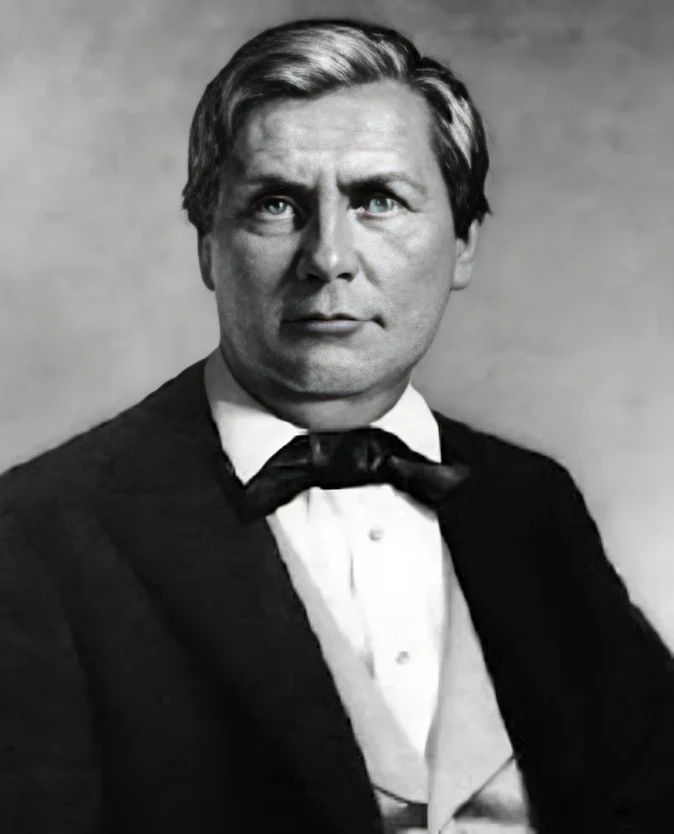
Charles Linn — born Carl Eric Engelbrekt Sjödahl on June 13, 1814, in Billnäs Bruk, Pojo Socken, Nylands Län, Finland, and died August 7, 1882, in Birmingham — was a sailor, wholesaler, banker, and industrialist.
Early Life in Finland
Linn was the son of Erik Johan Sjödahl, chief inspector of ironworks at Billnäs Bruk, and his wife, the former Engla Gustava Collin. The family was of Swedish descent and lived near Pojo, on the southwestern coast of Finland, which was then part of the Kingdom of Sweden.
Young Carl displayed an early affinity for seafaring. At age thirteen, after a great fire destroyed most of his school, the Imperial Academy in Turku, Sjödahl made his way to Helsingfors and boarded a ship bound for America. When the crew discovered the stowaway, they put him to work as a cabin boy until he could be returned home. During the voyage, he began learning English from the other sailors.
In April 1830, he returned to the sea as part of the crew of a merchant ship. Over the next decade he made the Atlantic crossing fifty-three times and completed three full circuits of the globe. On June 13, 1833, he registered as an immigrant to the United States in New York City.
Coming to America
Sjödahl apprenticed as a maker of matches and pursued that trade in New York, Savannah, and New Orleans, accumulating enough capital to purchase a packful of tinware, which he set off to peddle inland. He worked his way as far as Montgomery by 1838, resuming his match-making and selling business while sleeping on cotton bales at the riverside.
After a while, he partnered with Thomas Joseph in the fruit business, continuing to make matches to sell at their stand even after it expanded to include a bakery. To make it easier to do business, Sjödahl petitioned the state legislature to change his name to “Carl Linn,” which was further Anglicized to “Charles.”
Linn opened a mercantile business that flourished and made him a wealthy businessman. Finally ready to settle down, he purchased a large farm, then voyaged home to Finland and married his childhood sweetheart, the former Emelie Antoinette Forss, at Koskis on September 5, 1842, bringing her to Alabama as his wife.
Family and the Civil War
Linn and Emelie had four children: Elvina Charlotte (“Ellen”), Charles Washington, Antoinette “Annie” Aurelia, and Edward. Emelie died in Montgomery from complications with Edward’s birth on February 16, 1852. Linn did not remain long without a helpmate: on December 28 of that same year, he married the former Eliza Jane Summerlin of Montgomery, who over the next decade bore him four more children — Mary Eliza, Lizzie Jane, George Thomas, and George Marion.
At the outbreak of the Civil War, Linn sent all but his oldest son, Charles William, to Dresden for their safety. Linn and Charles William volunteered their services to the Confederate Navy and were posted to the Kate Dale, a fast sloop that ferried cotton through the Union blockades to trade in Great Britain and Cuba for gold and badly needed supplies. After many successful crossings, the ship was finally captured off the Florida Keys, and Linn and his son were taken prisoner and sent to Washington to stand trial as war criminals. Both were pardoned, and the two Linns joined the wholesale grocery firm of Flash, Lewis & Co. in New Orleans, recruiting fellow Finns from the docks as workers.
Birmingham Banker and Industrialist
After Charles William’s death in 1871, Linn sold his share in the New Orleans firm and rejoined the rest of his family at the farm in Montgomery. Not long afterward, James Powell and other investors in the Elyton Land Company interested him in the idea of opening a bank in the newly founded City of Birmingham. He agreed, launching the National Bank of Birmingham in 1872 with $50,000 in gold — the first bank in the city, and the first in Northern Alabama chartered under the National Bank Act.
In 1873, Linn was elected to the Birmingham Board of Aldermen to serve in Mayor James Powell’s administration. Later that year, he erected the monumental three-story National Bank of Birmingham building on the corner of 1st Avenue North and 20th Street, at a time when the city’s future was doubtful. The building became known as “Linn’s Folly,” and it was there that Linn hosted the legendary New Year’s Eve Calico Ball that signaled the city’s emergence from a cholera epidemic and the nationwide financial panic.
In 1874, Linn created a small park in a half-block behind the Relay House. He extended his investments from banking to industry, organizing two of the city’s first major manufacturing ventures — the Linn Iron Works and the Birmingham Car and Foundry Company — with skilled workers brought in from Cleveland and Cincinnati, and equipment purchased in part from the Confederate Iron Works in Selma.
Later Years and Legacy
Eliza Jane died on February 10, 1875, and Linn married the former Fannie H. Clark on August 24 of that same year. On Saturday, June 11, 1881, he hosted a celebration of his sixty-seventh birthday at Linn’s Park with bands, ice cream, and speeches; the day was also marked by an eclipse of the moon. He died a little over a year later, in August 1882.
Before his death, Linn issued a bold proclamation, which was inscribed on his mausoleum in Oak Hill Cemetery:
I shall have my tomb built upon a high promontory above the town of Birmingham, in which you men profess to have so little faith, so that I may walk out on Judgment Day and view the greatest industrial city of the entire South.
Downtown’s Linn Park was renamed for Linn in the 1980s, and the Linn-Henley Research Library is also named in honor of Linn and his descendants. In 2005, Linn was inducted into the Birmingham Business Hall of Fame. In 2013, a statue of Linn, sculpted by Branko Medenica, was installed at Linn Park by the Alabama-Mississippi Chapter of the National Multiple Sclerosis Society, commissioned to honor MS campaign chair Arthur Henley.
References:
Dubose, John Witherspoon (1887) Jefferson County and Birmingham, Alabama: Historical and Biographical Birmingham: Teeple & Smith, Publishers; Caldwell Printing Works.
Molton, Thomas Hunter (1922) Molton Family and Kinsmen. Birmingham: Birmingham Publishing Company
Corley, Robert G. and Marvin Yeomans Whiting, editors (July 1979) Dedication. Journal of the Birmingham Historical Society. Vol. 6, No. 2